Blue cheeses are renowned worldwide for their unique characteristics and unmistakable taste. In this article, we will explore the production technology and microbiological peculiarities that make these cheeses so special.
The Meaning of “Blue Veining”
It is said that the term “blue veining” originates from the Milanese dialect word “erborin” (parsley), used to describe the blue-green streaks typical of cheeses like Gorgonzola and Roquefort. Initially an Italian term, “erborinato” is now also commonly used in France, a leading producer of these cheeses.
Formation of the Veins
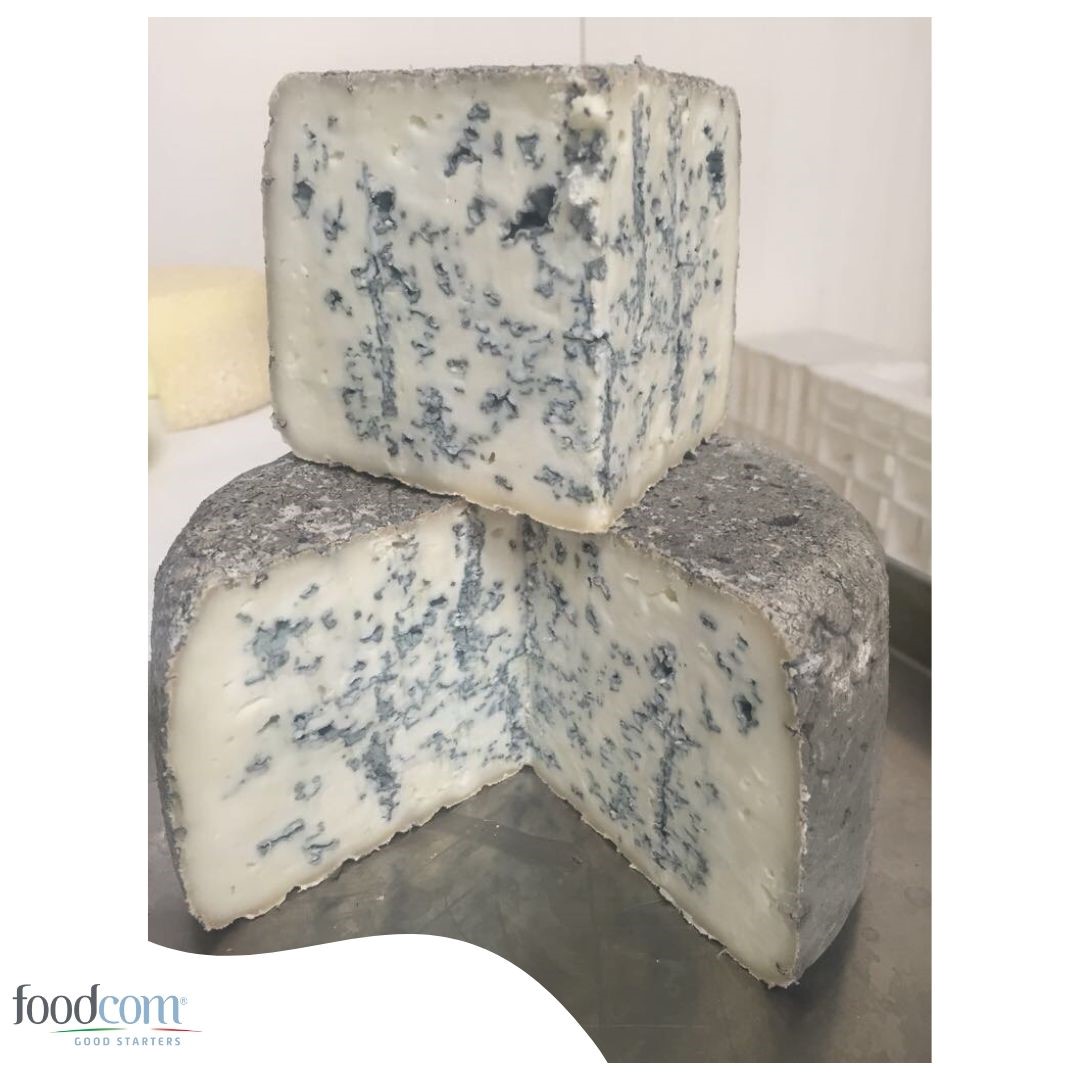
The distinctive veins of blue cheeses, whether mild or sharp, are created by mold from the Penicillium genus, such as P. roqueforti and P. camemberti. These molds spread their hyphae within the cheese through sporulation. The color of the veins depends on the presence of oxygen—since molds need air to breathe—as well as the specific characteristics of the mold itself, the pH of the cheese paste, and other conditions influencing its development and growth.
Structure of Blue Cheeses
To promote proper blue veining, the cheese paste must be porous to allow consistent aeration, but not overly rich in whey. This balance is achieved by producing dry curd granules, which ensure a partial fusion of the cheese paste.
Key Factors for Blue Veining
Two critical parameters determine the success of the blue-veining process:
- Thermo-hygrometric regulation of the ripening room: Maintain humidity around 90% (or higher) and a temperature between 4°C and 12°C, depending on the type of cheese, its moisture level, and the type of mold used.
- Internal aeration: Mechanical or manual perforation of the cheese using pins with variable diameters (5–8 mm) is essential for the proper diffusion of mold within the cheese wheel.
Types of Blue Cheeses
Blue cheeses can be divided into two main categories:
- Blue-veined cheeses: In these, the Penicillium roqueforti mold grows both on the surface and inside the cheese. A classic example is Gorgonzola, a famous Italian PDO cheese.
- White-veined cheeses: In these, the Penicillium camemberti mold develops only on the external surface. Well-known examples include Brie.
Other Molds Used
In addition to Penicillium roqueforti and P. camemberti, other molds contribute to the production of blue cheeses:
- Penicillium candidum: Used for “bloomy rind” cheeses.
- Geotrichum candidum: Used alone or in symbiosis with Penicillium to optimize the appearance and growth on the finished product.
Conclusion The production of blue cheeses is a fascinating and complex process in which molds play an essential role in giving cheeses their unique flavor and structure. This is due to the proteolysis and lipolysis effects, which can activate to varying degrees and thus define the cheese’s character. Understanding these processes allows us to better appreciate the variety and quality of blue cheeses available today.