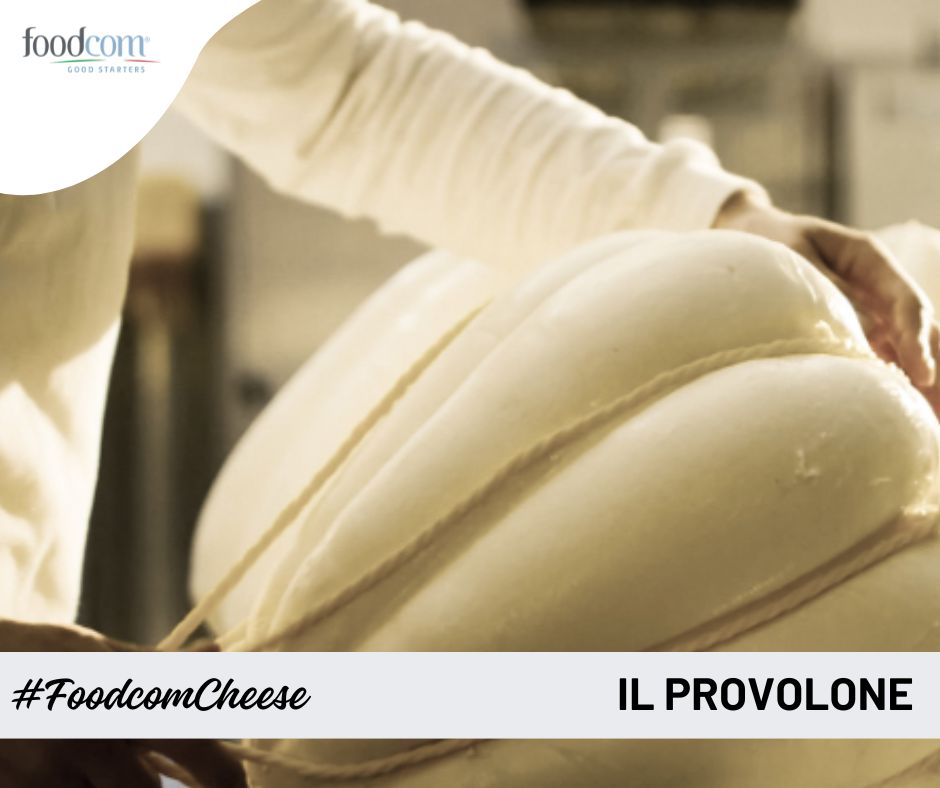
Today, we’re talking about a cheese that needs little introduction but certainly deserves to be told well: Provolone. A classic of Italian cheesemaking tradition, instantly recognizable at the first bite – and even before that, just by looking at it hanging by its string in its typical pear or salami shape.
Provolone originates in Italy, with strong roots in Lombardy, Veneto, and Campania, but it has long since crossed regional borders and is now appreciated everywhere. It is made from cow’s milk and belongs to the family of stretched-curd cheeses, just like mozzarella, although with very different characteristics. The production involves stretching the curd in hot water, making the paste elastic and moldable, but over time it can become firm and full of character.
A key factor that differentiates one Provolone from another is the aging process. It can range from just a few months (for a fresher, softer, more delicate version) to over a year, during which the cheese develops a firmer texture and a bold, full-bodied flavor. The color also changes, starting from ivory white and moving toward a deep straw yellow.
Flavor is another interesting aspect. Provolone can be sweet or sharp, and here the choice of rennet plays a decisive role. Using calf rennet produces a softer, milder cheese, ideal for those who prefer delicate flavors. On the other hand, goat or lamb rennet results in a Provolone with a stronger personality, with spiciness that increases with aging. According to recent data from the Protection Consortium, over 60% of Provolone produced in Italy is sold in its sweet version.
Provolone Valpadana, in particular, is protected by the PDO (Protected Designation of Origin) label, certifying its quality, origin, and traditional production methods. It’s a cheese that strikes a balance between technique and craftsmanship, between history and innovation.
Even the shape plays a role: salami, pancetta or pancettone, conical trunk, pear, mandarin, or mandarone. This isn’t just for looks – the shape influences how the cheese ages, how the rind forms, and how the inside dries.
And this is where we at Foodcom come in. If you produce Provolone, you know just how important every step is. That’s why we offer selected starter cultures, designed to respect the characteristics of cow’s milk and ensure a uniform, stable stretched curd. We also provide animal or microbial rennet, calibrated to the type of Provolone you want to produce. Sweet or sharp, short or long aging – every technical choice makes a difference. Finally, we supply wax for finishing: it protects, preserves, and makes your Provolone stand out even on the shelf. In short, from the first fermentation to the final touch, every detail counts – and with Foodcom, you have a partner who knows exactly how to support you through every stage of production.